Monday, November 24, 2008
Christmas Start
When the month of August comes to end, Filipino people will already start there Christmas countdown. Some radio stations will play christmas carols every now and then. Every department stores are all making space to display christmas decorations. People also start making and shopping christmas trees and decors for it will be much lesser when buying earlier before the month of December comes. Everyone is excited for Christmas day. Houses will be filled of christmas lights when the months that ends "ber" will come. So i wanna say advance merry christmas to all!

Monday, October 27, 2008
November Holiday In Philippines
Usually when the last week of October comes, Filipino families are already getting ready to what to do on the first day of November which is All Saints Day and on the second day, the All Souls Day. On the first day, some families already troop to the cemetery to prepare the grave sites of their loved one, instead of doing it on the All Souls day, a lot prefer visit the cemetery ahead of time.
The Filipino citizens treat the 1st and 2nd day of November as an almost festive event and has more of a "family reunion" atmosphere. It is said to be an "opportunity to be with" the departed and is done in a somewhat solemn way. When November 1 hits the calendar, the “Araw ng mga Patay” for the Filipinos start, as a celebration of the solemn and collective remembrance of the Day of the Dead. The almost festive movements are not short, for in fact lasts till the next day, which is the All Souls Day. Catholics in the Philippines have a tradition of setting aside their days to wind down and remember their dead loved ones. Since the Philippines have the most number of catholic citizens in the whole of Asia, a lot of people celebrate the fact that the whole of the state has a mandatory two day vacation for the whole country. People who are asked to work on those days need to be receiving a special rate of wage. This is a luxury that is granted to the Filipinos to commemorate for all the passed away souls of those who died and the saints. Although it would seem queer to some people that the Filipinos celebrate the solemn All Saints Day and All Souls Day in a joyous way, what they do not understand is that the Filipinos are naturally happy people. They truly respect their passed away loved ones very much, but they want to remember the good times with their ancestors instead of the bad.
There are some beliefs that Filipino people are still doing. Aside from bringing flowers and candles to offer on the graves. Some are also bringing foods to serve on their loved ones grave site. Those foods and drink that they think was the favorite of the one who passed away. At home prayer for the souls are also done. But aside from the praying, preparing foods or like offering foods are also done. The one who are leading for the prayer in sometimes will call the deads name as if they are invited to eat and drinks.
The onset of All Soul's Day in places where the inhabitants are mostly Catholics suggests a deluging in the local markets of assorted candles of colors, shapes and scents and of a variety of flowers freshly picked from a native farm. The hullabaloos in the flea markets reached as far as the super marts and department stores where people can be seen hurrying to and fro, doing a last minute buying of the things they will need in preparing for the occasion. Such a typical Filipino setting indeed and so much like Christmas Eve, the difference is it's not Christmas and it's not for the living. It is All Soul's Day and it's for the dead.
The Filipino citizens treat the 1st and 2nd day of November as an almost festive event and has more of a "family reunion" atmosphere. It is said to be an "opportunity to be with" the departed and is done in a somewhat solemn way. When November 1 hits the calendar, the “Araw ng mga Patay” for the Filipinos start, as a celebration of the solemn and collective remembrance of the Day of the Dead. The almost festive movements are not short, for in fact lasts till the next day, which is the All Souls Day. Catholics in the Philippines have a tradition of setting aside their days to wind down and remember their dead loved ones. Since the Philippines have the most number of catholic citizens in the whole of Asia, a lot of people celebrate the fact that the whole of the state has a mandatory two day vacation for the whole country. People who are asked to work on those days need to be receiving a special rate of wage. This is a luxury that is granted to the Filipinos to commemorate for all the passed away souls of those who died and the saints. Although it would seem queer to some people that the Filipinos celebrate the solemn All Saints Day and All Souls Day in a joyous way, what they do not understand is that the Filipinos are naturally happy people. They truly respect their passed away loved ones very much, but they want to remember the good times with their ancestors instead of the bad.
There are some beliefs that Filipino people are still doing. Aside from bringing flowers and candles to offer on the graves. Some are also bringing foods to serve on their loved ones grave site. Those foods and drink that they think was the favorite of the one who passed away. At home prayer for the souls are also done. But aside from the praying, preparing foods or like offering foods are also done. The one who are leading for the prayer in sometimes will call the deads name as if they are invited to eat and drinks.
The onset of All Soul's Day in places where the inhabitants are mostly Catholics suggests a deluging in the local markets of assorted candles of colors, shapes and scents and of a variety of flowers freshly picked from a native farm. The hullabaloos in the flea markets reached as far as the super marts and department stores where people can be seen hurrying to and fro, doing a last minute buying of the things they will need in preparing for the occasion. Such a typical Filipino setting indeed and so much like Christmas Eve, the difference is it's not Christmas and it's not for the living. It is All Soul's Day and it's for the dead.
Thursday, September 11, 2008
Philippines Street Foods

In Philippines, you can observe various street foods being sold in any part of the busy city streets or at the small community. 
barbecue vendor
Street food is food obtainable from a streetside vendor, often from a makeshift or portable stall with the very affordable prices. Most street food is both finger and fast food.The most common Philippines street foods include fried squidballs, fishballs, kikiams (a type of processed chicken, which are served on a stick, with a variety of dipping sauces). 
fish balls and squidball vendorRoadside stands also serve barbecued pork, chicken and offal, such as pig's blood (colloquially, Betamax after its rectangular shape), chicken heads (helmet), chicken feet (adidas) pig's ears and chicken intestines (isaw).
 Among more esoteric foods are balut and penoy (duck eggs; with fetus and without, respectively), tokneneng and quek-quek (battered, deep-fried chicken and quail eggs) and deep-fried day-old-chick.
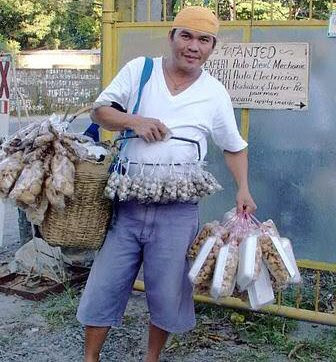 selling balut, chicharon and boiled quail eggs (above)
 balut (from youngest to eldest chick)
You can also discover Taho, a type of soft beancurd served with syrup and tapioca balls is another snack.
 taho
tahoPalamig (literally, coolers) are sold, such as traditional offerings like halo-halo (halo means mix) and many kinds of fruit juices. Sorbetes (or, colloquially, "dirty ice cream") and locally-produced ice-cream in exotic flavors such as mango, cheese and yam.
 There are a lot more street foods that i have not mention. It's up to you to discover those foods when you will visit Philippines.
Sunday, September 7, 2008
Kalesa in Philippines
 Another transportation that can be found in the country is a kalesa (sometimes called a karitela). It is a horse-driven carriage use in the Philippines. The word, also spelled calesa, meaning "wheels." This was one of the modes of transportation introduced in the Philippines in the 18th century by the Spaniards that only nobles and high ranked officials could afford, but today you ride kalesa so you can save fare. They are rarely used in the streets nowadays, but here in our city you still can see it at the market area going to some baranggay. Only a few times i ride kalesa (tartanilya as it is called in iligan city), the first time is quite uneasy because i'm afraid to fall off from the cart but it's fun.
Philippine Fiesta
Last August 28, 2008 we celebrated our fiesta here in our barrio (small community) for our patron San Agustin. The fiesta is part and parcel of Filipino culture. Through good times and bad times, the Filipino fiesta must go on. Each city and barrio has at least one local festival of its own, usually on the feast of its patron saint, so that there is always a fiesta going on somewhere in the country.The Philippine fiesta is a lot more that it seem on the service. It is the tie that binds Filipinos from a region or an area together, a time to reunite with our extended family and our countrymen. No matter where they are, they are expected to attend. It is a time to rejoice in friendship, spend all you have, forget the expense, just be happy you can afford to entertain and feed others, if you can. When i was still a kid, i was wondering why we really need to prepare something just to feed those people who will be our visitor on our fiesta. My mother answered me that it's like a thanksgiving for all the graces that is given to our family and sharing it to others. City fiesta are more fun than those in the barrios (small community) because usually big events happen. After the fiesta celebration of our barrio, Iligan City will celebrates its City Fiesta this September 29. Before the fiesta dates, there will be many events. Highlighted by the traditional Diyandi, Eskrima and the street drama. The Diyandi (ritual dance) is performed only during the feast of Iligan Patron Saint, Senior San Miguel. Other curious dance-forms, also performed during the San Miguel Fiesta, include the Eskrima (a dance simulating a fight between San Miguel and his enemies, and the Yawa-yawa, literally, devil-devil), a dance from depicting the celestial battle between the forces of good and evil as impersonated by St. Michael, the Archangel and Lucifer.


KASADYA(street dancing and merry-making) was started, as a local form of entertainment has become a major tourist attraction of Iligan drawing crowds both local and tourist alike. This happens every 27th of September at early morning. It is considered as a non-income generating project having the most number of spectators both in the streets and in the showdown venue proper as compared to other tourism related activities.


Monday, September 1, 2008
Letchon Baboy in Philippines
Filipinos are very fun of celebrations especially birthdays, weddings, fiestas and many other occassions. The whole roasted pig or "lechon baboy " is a popular dish in any of the festivities in the Philippines. Usually parties are not complete without this. Lechon baboy also economical and easier than preparing many other kinds of pork recipes because dealing about cost of spicies to be used for different foods, which is become expensive. The method of cooking the lechon is that the whole pig is roasted slowly over live charcoal. The tedious method of long-hours roasting the whole pig leaves the meat very tender inside and a crispy skin outside. Here is big lechon baboy photo taken from my friend's birthday.
Friday, August 29, 2008
Philippine Style

We can see many restaurants here in Philippines that peoples are eating using their bare hands. Usually restaurants that serves either roasted or grilled foods with rice of course. Eating foods like this with the hands is far easier than eating with cutlery no matter how habituated one may be to using forks, spoons, or knives. In defense of the practice of eating with the fingers it may be said that this leads to a certain minimum level of hygiene. It forces people to wash their hands before and after meals. And it says its more enjoyable eating with your fingers. Try it so you will know.
Thursday, August 28, 2008
An Example of a Filipino Trait

In the Philippines, the people have a lot of traits to be followed from their elders. One of those traits is doing "mano". Upon arriving home, families expect children to practice the kissing of hands or placing their parents or elder family members’ hand to their foreheads with the words “mano po” as a sort of greeting. In return they will say "kaawaan ka ng Diyos" which means God Bless you. This is one thing that my american boyfriend noticed when he visited me here in the Philippines. He asked me what i was doing when i get the hand of my grandfather when we arrived at his house. I told him it's one sign of respect to elder people here in Philippines. It is good that we can know the difference from other countries specially on the traits that we have in our own country.
Subscribe to:
Posts (Atom)