Followers

Check Page Rank of your Web site pages instantly:

This page rank checking tool is powered by Page Rank Checker service

Showing posts with label philippines food. Show all posts

Wednesday, March 11, 2009

kaldereta


Kaldereta is a dish popular in the Philippines, especially in Luzon island. Its common ingredients are cuts of pork, beef or goat with tomato paste or tomato sauce with liver spread added to it. In Metro Manila it is more commonly added with potatoes but in other regions such as Southern Tagalog provinces, it is simply the sauce and the cuts of meat that are used. There are other meats that can also be used such as chicken but pork, beef and goat are the three more popular cuts of meat used.

Thursday, March 5, 2009

Typical Filipino Meal

Filipino cuisine is distinguished by its bold combination of sweet, sour and salty flavors, and in general most dishes are not heavily spiced. While other Asian cuisines may be known for a more subtle delivery and presentation, Filipino palates prefer a sudden influx of flavor. Filipino cuisine is often delivered in a single presentation, giving the participant a simultaneous visual feast, an aromatic bouquet, and a gustatory delight. Counterpoint is also a feature in Philippine cuisine. This normally comes in a pairing of something sweet with something salty, and result in surprisingly pleasing combinations. Examples include: champorado (a sweet cocoa rice gruel), being paired with tuyo (salted, sun-dried fish); dinuguan (a savory stew made of pig's blood and innards), paired with puto (sweet, steamed rice cakes); unripe fruits such as mangoes (which are only slightly sweet but very sour), are eaten dipped in salt; the use of cheese (which is salty) in sweetcakes (such as bibingka and puto), as well as an ice cream flavoring.
Snacking is normal, a Filipino may eat five 'meals' in a day. Dinner, while still the main meal, is smaller than other countries. Usually, either breakfast or lunch is the largest meal.

Lechon

Lechón is the Spanish word for suckling pig. In the Philippines, it connotes a whole roasted pig, litsong baboy. Chicken and beef are also popular. The process of lechón involves the whole pig/piglet, chicken, or cattle/calf being slowly roasted over charcoal. Lechón is often cooked during national festivities (known as fiestas), the holiday season, and other special occasions such as weddings, graduations, birthdays and baptisms, or family get-togethers. The lechón is usually the highlight and the most popular dish of these events. It is usually served with a liver-based sauce. The typical Filipino method of roasting involves placing the pig on a spit and roasting it over charcoals while wiping the skin with a brush made out of leaves drenched in water and the pig's own fat. This makes the skin "pop" and become crunchy. The term "lechón" is also now used to refer to meat cooked on a spit (often whole) such as "litsong baka" (beef) and "litsong manok" (chicken). In fact, there are numerous brands of litsong manok stalls found scattered in the metropolis. The pig had always been the center of communal feasts in pre-Hispanic Philippines, and "lechón" is the normal manner it is prepared.

Tuesday, March 3, 2009

Tinola

Another Filipino dish that i like very much is Tinola. It is a soup-based dish served as an appetizer or main entrée in the Philippines. Traditionally, this dish is cooked with chicken, wedges of green papaya, and chili pepper leaves, in broth flavored with ginger, onions and fish sauce. A common variant substitutes pork for chicken, chayote instead of papaya, or moringa leaves known as marungay or malunggay, instead of pepper leaves. It is best served with fresh chicken. You can check the recipe online and here is a sample.

Thursday, February 26, 2009

Sinigang in Philippines

Sinigang is a Philippine soup that is eaten with rice. Its characteristic flavor comes from tamarind which gives it a sour taste and overwhelms the taste of its meat. Sinigang is a started as a meat (e.g., fish, pork, chicken, shrimp, or beef) stewed with tamarind, green pepper, tomato, and onion. Other vegetables cooked in sinigang include okra, taro corms, labanos, kangkong, sitaw and eggplant. Another variety is prepared with guava and is less sour than those with tamarind. Raw mango, calamansi and kamias can also be utilized. However, vinegar is not used for making sinigang sour, soups made with vinegar are called paksiw. Powdered soup base or bouillon cubes for sinigang are also used in place of natural fruits. Chicken sinigang is called sinampalukan (from sampalok, Filipino for tamarind). Sinampalukan is made with shredded tamarind leaves, ginger, onions, and tomatoes. Sinampalukan is sometimes prepared to be a little spicier than the other sinigang dishes. My american boyfriend tasted sinigang when he visited here in Philippines and he wanted to have soup so i ordered sinigang for him and he likes it.

Saturday, February 21, 2009

Pancit Malabon

Pancit Malabon is a type of pancit, or stir-fried noodle dish, which originated in Malabon City, Metro Manila, Philippines. It has a yellow-orange color due to a sauce that includes patis (fish sauce) and bagoong (shrimp paste). Its toppings draw heavily from the fresh seafood that is available in the area and may include fresh shrimp, squid, oysters, and hard-boiled duck or hen eggs, as well as pork. This noodle dish can be serve in any meal, it can be snack, a dinner or if you double the amounts, this can go well in big gatherings. So when you will visit the Philippines, don't forget to taste the Pancit Malabon.

Saturday, February 14, 2009

Cassava

Cassava is one of the important source of food, feed and starch among Filipinos. Is known to perform well even under unfavorable growing condition such as drought and poor soils. Though less government support, cassava contributes around 2% of gross value added in agriculture. This crop is endowed with especial capacity to contribute to the development of food security and poverty alleviation in the country. Cassava is the third largest source of carbohydrates for human food in the world, with Africa its largest center of production. The flour made of the roots is called tapioca. Cassava is harvested by hand by raising the lower part of stem and pulling the roots out of the ground, then removing them from the base of the plant . The upper parts of the stems with the leaves are plucked off before harvest. Cassava is propagated by cutting the stem into sections of approximately 15 cm, these being planted prior to the wet season. Traditionally the Cassava root, after maturing, is left in the ground and harvested when needed. This "underground storage practice" has many disadvantages because it makes land unavailable for further cultivation, and the quality of the roots diminishes with storage in the soil and leaves roots unsuitable for many types of processing. Increasing land pressure, population growth, and expansion of area under cultivation resulted in the evolution of storage of dried Cassava chips. Changes in farming systems have affected harvesting and storage patterns and caused farmers to store Cassava in large amounts in storage structures with increasing susceptibility to attack by insects and fungi.

Wednesday, February 11, 2009

Adobo

Adobo is the name of a common and very popular cooking process in the Philippines; indeed it is considered a national group of dishes. The usual method in preparing adobo in these countries uses pork and spices, especially red peppers.Typically, pork or chicken, or a combination of both, is slowly cooked in soy sauce, vinegar, crushed garlic, bay leaf, and black peppercorns, and often browned in the oven or pan-fried afterward to get the desirable crisped edges. This dish originates from the northern region of the Philippines. It is commonly packed for Filipino mountaineers and travelers. Its relatively long shelf-life is due to one of its primary ingredients, vinegar, which inhibits the growth of bacteria. The standard accompaniment to adobo is white rice. Outside the home-cooked dish, the essence of adobo has been developed commercially and adapted to other foods. A number of successful local Philippine snack products usually mark their items "Adobo-flavored." This assortment includes, but is not limited to nuts, chips, noodle soups, and corn crackers.

Wednesday, February 4, 2009

Biko

Rainy season like this, we crave for something to eat while we are just here inside the house doing nothing. My sister was telling me that we will make Biko today for we have glutinous rice that mother bought the other day, but we haven’t prepared coconut to be used for it and it was already raining. So we just took a nap and will make Biko maybe in the next day. What is Biko? It is a cake made from glutinous rice cooked in sweetened coconut milk and topped with latik (curdled coconut cream), but some just make it plain with no toppings. Biko is usually served during birthday parties, fiestas, Christmas, New Year and other celebrated events in the Philippines.

Tuesday, February 3, 2009

Dried Mango

If you are looking for something sweet and healthy food as well while you are here in the Philippines, then you might try Cebu's dried mangoes. It is the best tasting dried mangoes in the country, if not in the world. Though there are a lots of mangoes from other part of the country but Cebu City has the reputation for have fresh and sweet mangoes. The tasty, nutritious and convenient dried mangoes have become a huge hit and a standard food pasalubong (gift) to take to friends and relatives in the West.

Tuesday, January 27, 2009

Yummy Bibingka

Bebinca, also known as bibik, is a traditional Goan dessert. The ingredients include plain flour, sugar, ghee (clarified butter) and coconut milk.This food is popular in the Philippines, where it is known as bibingka (bingka in bisaya). The dessert is baked in a specially-made clay oven, with hot coal as a source of heat, placed above. It has to be baked in layers and traditionally has 16 layers. In the Filipino method of preparation, rice flour is used (the baking process is similar to that of the bebinca). Before being served, butter or margarine is spread and sugar is sprinkled over the bibingka. It is typically served with grated coconut. Bibingka is always present for christmas season in the Philippines and also at carnival when their is community fiesta.

Sunday, January 18, 2009

Sukang Pinakurat

A homegrown food processing family business is taking the whole country and soon, the rest of the world by surprise. The Pinakurat is the now famous brand of vinegar made in Iligan City. And there seems no stopping its growing fame because it has not only become the must-have pasalubong from visitors of this city of waterfalls, but it is the most in demand padala to Filipinos abroad. Sukang Pinakurat is that spicy vinegar made from fermented coconut nectar and spices grown in the farmlands of Iligan City and Lanao del Norte. Its mercuric rise to the top of the condiment and dip business owes primarily to the fact that it takes over one’s taste buds and gives the pulutan or any food that needed zzzing! The word “pinakurat” is an affixation of the Sebuano (correct spelling instead of “Cebuano” according to language scholars) root word “kurat.” “Kurat,” according to De la Cruz, means surprise. Thus, “pinakurat” means in a sudden or surprising manner as to shock the person. “Since the taste of the vinegar mixed with the spices was very similar to that used in the pinakurat dish, we decided to name our product after it,” explained Stuart del Rosario. And sure enough, sukang Pinakurat’s taste took everyone by surprise. “Papawisan ka sa sarap” (you’ll break out into a sweat from its spiciness) so the ad goes. The sukang Pinakurat indirectly provides 500 jobs to farmers who supply the coco nectar and spices from the different farmlands in and around Iligan. According to Stuart del Rosario’s son, Rene “Peppo” Jr., who now manages the family business, they plan to ship the sukang Pinakurat to Australia, Canada and parts of the United States.

Thursday, December 25, 2008

Traditional Noche Buena Food

Noche Buena, often translated as "Good Night", is a Spanish word referring to the night of Christmas Eve. In the Philippines, this usually comes after the entire family has attended a late evening mass. Often on the table are: lechón, pancit, fried chicken, lumpia, rice, adobo, among others for the main course; desserts include halo-halo, bibingka, rice cakes, puto bumbong, ice cream, pastries and cakes; drinks include soda, wine, beer, juice, and goat milk. The Noche Buena is very much like an open house celebration. Family, friends, relatives, and neighbors drop by to wish every family member "Maligayang Pasko" (Merry Christmas). Food is in abundance, often served in buffet style. Guests or visitors partake of the food prepared by the host family (even though they are already full or bloated!). Though not all family can afford to prepare for a big traditional Noche Buena because of the crisis today, still a simple get together can make a happy and simple celebration.

Monday, December 22, 2008

Filipino Cuisine

Filipino cuisine is distinguished by its bold combination of sweet, sour, salty and spicy flavors, though in general most dishes are not heavily spiced. While other Asian cuisines may be known for a more subtle delivery and presentation, Filipino palates prefer a sudden influx of flavor. Filipino cuisine is often delivered in a single presentation, giving the participant a simultaneous visual feast, an aromatic bouquet, and a gustatory delight.
Snacking is normal, a Filipino may eat five 'meals' in a day. Dinner, while still the main meal, is smaller than other countries. Usually, either breakfast or lunch is the largest meal. Main dishes include sinigang (pork, fish, or shrimp in tamarind soup and vegetables), bulalo (beef soup – commonly with marrow still in the beef bone – with vegetables), kare-kare (oxtail and vegetables cooked in peanut sauce), crispy pata (deep fried hog hoofs with hock sometimes included), mechado (pork cooked in tomato sauce), pochero (beef or pork cooked in tomato sauce with bananas and vegetables), kaldereta (beef or goat cooked in tomato sauce), fried or grilled chicken/porkchops/fish/squid/cuttlefish. Some dishes rely on vinegar for flavoring. Adobo is popular not solely for its splendid flavor, but also for its ability to remain fresh for days, and even improves its flavor with a day or two of storage. Tinapa is a smoke-cured fish while tuyo, daing, and dangit are corned, sun-dried fish popular because they can last for weeks without spoiling, even without refrigeration.

Monday, December 15, 2008

Philippines Christmas Delicacies

Philippines is known to have many different kinds of native delicacies. Vendors offer a wealth of native delicacies in front of churches after the Misa de Gallo (Simbang-gabi). After hearing Mass, Filipino families partake of traditional Philippine Christmastime delicacies, either during breakfast at home or immediately outside the church. Some of these are bibingka (rice flour and egg based cake, cooked using coals on top of and under the pastry), Misa de Gallo Puto Bumbong (a purple-colored Filipino dessert made of sweet rice cooked in hollow bamboo tubes placed on a special steamer-cooker. When cooked, they are spread with butter and sprinkled with sugar and grated coconut), salabat (hot ginger tea) and tsokolate (thick Spanish cocoa).

Saturday, December 13, 2008

Halo- Halo in Philippines


Eventhough it's not summer time in Philippines but sometimes the weather is still too hot. Halo-Halo (also spelled Halu-Halo) is a Filipino treat perfect for tropical climes. Although referred to as a dessert, it's actually more common to eat it as a stand-alone snack, especially in the middle of a hot afternoon. It's literally meaning "Mix-Mix" and it's a blend of fruits, sweet preserves, evaporated milk and shaved ice. Imagine that. Now if that doesn't make you drool, think about the combination of red munggo beans, kidney beans, garbanzo beans, sugar palm fruit (kaong), coconut sport (macapuno), jackfruit (langka), tapioca or sago, nata de coco, purple yam (ube) or sweet potato (kamote), sweetened corn kernels or pounded crushed rice (pinipig), leche flan or custard, evaporated milk and gelatin. And to top that vision add up a scoop or two of your favorite ice cream! Just thinking about halo-halo makes my mouth water. It is available rain or shine, halo-halo serves as a delight to all food trippers, young and old alike. In Iligan City, Philippines, a number of fastfoods and restaurants serve halo-halos which will surely make you come back and ask for more. During the peak of the Philippine summer (April and May), makeshift stands are set up all over by people selling halo-halo. The ingredients are laid out on a table and the customer gets to choose which to have added to his or her order. Indoors, it's easier to have halo-halo topped off with a scoop of ice cream. Make sure to halo (mix) thoroughly before digging in. Yes, mixing all those goodies at the bottom without spilling the ice and ice cream off the glass is a skill that needs to be honed by regular indulgence!

Friday, December 12, 2008

Rice


Rice is most common cereal grain in Philippines and is always present in everday Filipino meal. The table is not complete without a plate of rice serve. Many farmers are planting rice, specially in land that is near to water source and the have a moist area. The love for rice of Filipino people results this wonderful rice terraces in Banaue, Philippines. This terraces are 2000-year old terraces that were carved into the mountains of Ifugao in the country by ancestors of the Batad indigenous people. The Rice Terraces are commonly referred to by Filipinos as the " Eighth Wonder of the World". It is commonly thought that the terraces were built with minimal equipment, largely by hand. The terraces are located approximately 1500 meters (5000 ft) above sea level and cover 10,360 square kilometers (about 4000 square miles) of mountainside. They are fed by an ancien irrigation system from the rainforests above the terraces. It is said that if the steps are put end to end it would encircle half the globe.


Thursday, December 11, 2008

Philippines Seafood


Seafood is popular as a result of the bodies of water surrounding the Philippines archipelago. In any part of the country you can see and surely will love to taste the delicious seafood that everybody will offer. Seafood is cheaper in area that is near on shores and also is more fresh because it does not need to be travelled far to sell. Popular catches include tilapia,catfish(hito), (bangus), grouper (lapu-lapu), shrimp(hipon), prawns (sugpo), mackerel(galunggong), swordfish, oysters (talaba), mussels (tahong), clams (tulya), large and small crabs(alimango and alimasag respectively), game fish, gindara or sablefish, tuna, cod, blue marlin, and squid/cuttlefish (both called pusit). Equally popular catches include seaweeds, abalone and eel. There are many more kinds of seafood in market area we can see that are sold in a very affordable prices.

Wednesday, December 10, 2008

Jollibee in Philippines

If you are thinking for a fast food chain when you are in Philippines, i am sure someone would tell you about Jollibee. It is an American-style fast-food restaurant with Filipino-influenced dishes specializing in burgers. They do value their customers a lot and although Jollibee does have an American-style fast food, you can still feel the Filipino legacy. They especially value their loyal customers by having occasional promos and discounts. They also prioritize the children and they offer kiddie meals, parties, mascot appearances and some facilities such as a playground. The Jollibee stores are conveniently placed around the city. Kids love it especially my cousins, if you will mention the name "Jollibee" you can surely see the smile on their faces. Jollibee quickly grew as one of the top companies all over Asia and the most admired fast food chain in the country.

Thursday, September 11, 2008

Philippines Street Foods

In Philippines, you can observe various street foods being sold in any part of the busy city streets or at the small community.
barbecue vendor

Street food is food obtainable from a streetside vendor, often from a makeshift or portable stall with the very affordable prices. Most street food is both finger and fast food.The most common Philippines street foods include fried squidballs, fishballs, kikiams (a type of processed chicken, which are served on a stick, with a variety of dipping sauces).
fish balls and squidball vendor

Roadside stands also serve barbecued pork, chicken and offal, such as pig's blood (colloquially, Betamax after its rectangular shape), chicken heads (helmet), chicken feet (adidas) pig's ears and chicken intestines (isaw). Among more esoteric foods are balut and penoy (duck eggs; with fetus and without, respectively), tokneneng and quek-quek (battered, deep-fried chicken and quail eggs) and deep-fried day-old-chick.
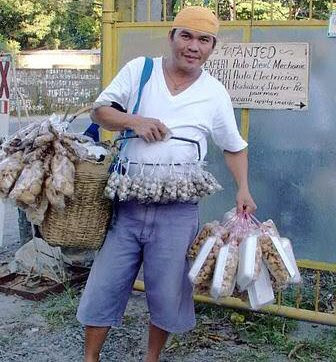
selling balut, chicharon and boiled quail eggs (above)

balut (from youngest to eldest chick)

You can also discover Taho, a type of soft beancurd served with syrup and tapioca balls is another snack.

taho

Palamig (literally, coolers) are sold, such as traditional offerings like halo-halo (halo means mix) and many kinds of fruit juices. Sorbetes (or, colloquially, "dirty ice cream") and locally-produced ice-cream in exotic flavors such as mango, cheese and yam.

There are a lot more street foods that i have not mention. It's up to you to discover those foods when you will visit Philippines.